Mirror Pavilion
In the Imperial Park, at the highest point of the trail route in the park, north of the Imperial Villa, on the edge of the forest
In the Imperial Park, at the highest point of the trail route in the park, north of the Imperial Villa, on the edge of the forest
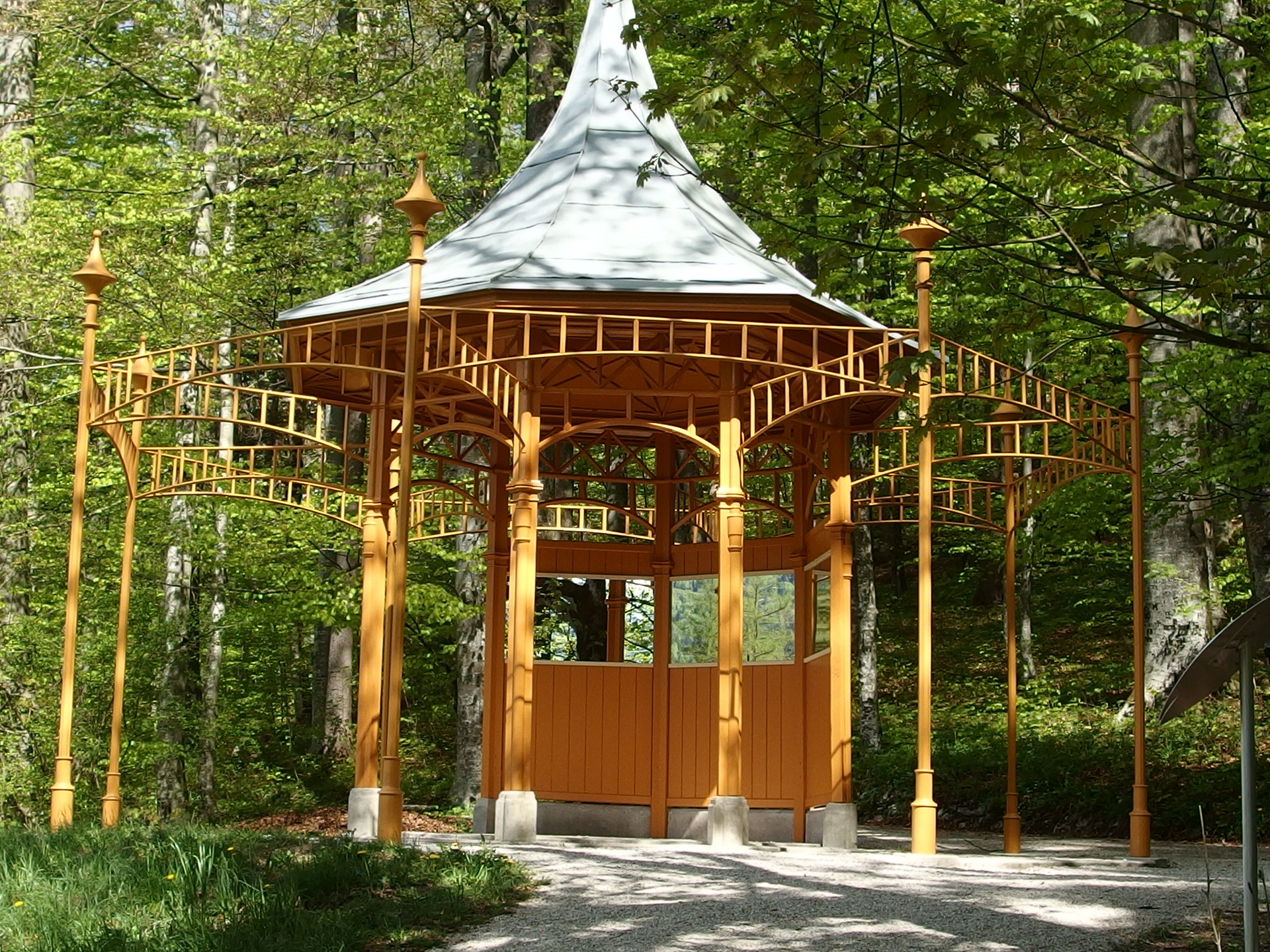
The unconventional pavilion, presumably designed by Court Gardener Franz Rauch around 1855, was sometimes also called "Chinese Pavilion" because of its curved tent roof. Some also called the pavilion "Gloriette" because of its elevated position, with a magnificent view to the south (Ischl, Dachstein glacier).
The garden pavilion consists of an octagonal wooden scaffolding with a pointed tin roof braced with iron parts. The scaffolding is surrounded by an octagonal cast iron construction that is connected to the inner woods by cantilevers. The probable intention was for creepers to climb up the cast iron parts. The three mountain-side spaces between the wooden posts were previously filled with wooden walls and covered with mirrors, in which the impressive panorama was reflected (hence, the pavilion’s name: Mirror Pavilion). The concrete foundations are evidence of a later renewal. The table and the benches are new.